
If you’re new to online business, you’ve probably heard the term digital marketing everywhere.
You might see people talking about SEO, social media, email marketing, paid ads, content creation, and a dozen other things. At first, it can feel like there’s a lot to learn.
The good news is that you don’t need to learn everything at once.
This guide to digital marketing for beginners will walk you through the basics, explain how the different parts work, and show you how you can start learning and practicing digital marketing in 2026.
What Is Digital Marketing?
Digital marketing is simply the process of promoting a business, product, service, or brand using the internet and digital channels.
Instead of relying only on traditional methods like newspapers, billboards, or television, businesses can reach people through:
- Search engines
- Websites
- Social media
- YouTube
- Online advertising
- Mobile apps
- Content platforms
For example, if a company publishes a blog post that appears in Google search results, that’s digital marketing.
If a business runs an Instagram ad, that’s digital marketing too.
Even sending a promotional email to customers is part of digital marketing.
In short, digital marketing is a very broad field, and there are many different ways to approach it.
Why Is Digital Marketing Important in 2026?
People spend a huge amount of time online.
They search Google when they need answers, watch videos before buying products, check social media for recommendations, and compare businesses online before making decisions.
That means having an online presence isn’t just useful for large companies.
Small businesses, freelancers, creators, bloggers, and online stores can all use digital marketing to reach potential customers.
Another advantage is that digital marketing can be measurable.
With the right tools, you can often see things like:
- How many people visited your website
- Where visitors came from
- Which pages they viewed
- How many people clicked an advertisement
- How many visitors became customers
This information can help you figure out what’s working and what needs improvement.
The Main Types of Digital Marketing
Digital marketing isn’t one single strategy.
It’s made up of several different areas, and you don’t need to master all of them immediately.
Here are the most important ones to understand.
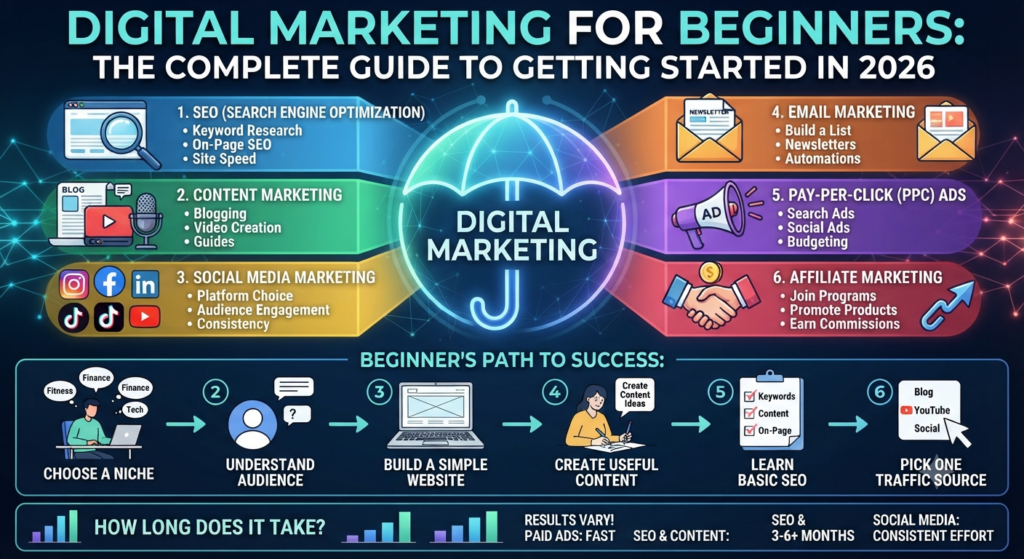
1. Search Engine Optimization (SEO)
SEO is the process of improving your website and content so that it has a better chance of appearing in search engine results.
For example, imagine you own a website about fitness.
You might create an article called:
“Best Home Workouts for Beginners.”
If the article is useful and well optimized, it could eventually appear when people search for related topics.
SEO can bring you traffic without paying for every visitor.
However, it usually takes time.
You need useful content, a good website, and patience.
Basic SEO Tips for Beginners
Start with simple things:
- Research what your audience is searching for
- Write useful content that answers those questions
- Use clear titles and headings
- Make your website easy to navigate
- Optimize page speed and mobile usability
- Link to relevant pages on your own website
- Avoid stuffing keywords into every sentence
Good SEO isn’t about tricking Google.
It’s about making your content genuinely useful to people.
2. Content Marketing
Content marketing means creating useful content to attract and build relationships with an audience.
This can include:
- Blog posts
- Videos
- Tutorials
- Guides
- Podcasts
- Infographics
- Social media posts
- Newsletters
For example, a company selling accounting software could publish articles about small-business taxes, bookkeeping, and managing business expenses.
People searching for those topics may discover the company through its content.
The goal isn’t always to make a sale immediately.
First, you provide value.
Then, over time, some of those visitors may become customers.
3. Social Media Marketing
Social media marketing involves using platforms such as Instagram, Facebook, TikTok, LinkedIn, Pinterest, and YouTube to reach an audience.
The right platform depends on your audience.
For example:
- LinkedIn can be useful for B2B businesses and professionals.
- Instagram can work well for visual brands and creators.
- TikTok is popular for short-form video content.
- YouTube is useful for tutorials, reviews, and long-form video.
- Pinterest can be useful for certain visual and search-driven niches.
You don’t need to be active on every platform.
In fact, beginners are often better off choosing one or two platforms and learning how to use them properly.
4. Email Marketing
Email marketing is one of the oldest forms of digital marketing, but it remains useful.
The basic idea is simple.
Someone gives you permission to send them emails, and you use that relationship to provide useful information, updates, offers, or content.
For example, an online store might send:
- New product announcements
- Discounts
- Helpful tips
- Personalized recommendations
- Weekly newsletters
One advantage of email marketing is that you’re communicating directly with people who have chosen to hear from you.
Just remember that good email marketing isn’t about sending endless promotional messages.
Give people a reason to stay subscribed.
5. Pay-Per-Click Advertising (PPC)
PPC advertising allows businesses to pay for online advertisements.
Common examples include search ads and social media advertising.
For example, a company might pay to show an advertisement when someone searches for a specific product or service.
PPC can generate traffic quickly, but there’s a catch.
You have to pay for that traffic.
If you don’t understand your audience, targeting, landing pages, and conversion rates, it’s easy to waste money.
That’s why beginners should learn the basics before spending a large advertising budget.
6. Affiliate Marketing
Affiliate marketing is another part of digital marketing.
Instead of selling your own product, you promote someone else’s product or service and earn a commission when your referral generates a qualifying action.
For example, you might run a website about AI tools and publish a review of an AI writing platform.
If the company has an affiliate program, you could include a referral link in the article.
If a reader purchases through your link and the referral qualifies, you earn a commission.
Affiliate marketing can work particularly well with:
- Blogs
- YouTube channels
- Review websites
- Niche websites
- Social media content
But like any online business model, it takes time to build an audience.
How to Start Digital Marketing as a Beginner
If you’re completely new, don’t try to learn everything in one week.
Here’s a much simpler approach.
Step 1: Choose a Niche
Start by deciding who you want to help and what topic you want to focus on.
For example:
- Fitness
- Personal finance
- AI tools
- Technology
- Travel
- Food
- Education
- Small business
- Productivity
You don’t have to choose a perfect niche immediately.
Pick something you’re interested in and where you believe you can consistently create useful content.
Step 2: Understand Your Audience
Once you’ve chosen a niche, think about the people you’re trying to reach.
Ask yourself:
What problems do they have?
What questions are they asking?
What are they trying to achieve?
This is more important than simply thinking about keywords.
If you understand your audience, creating content becomes much easier.
Step 3: Build a Website
You don’t necessarily need a complicated website.
A simple, clean website with useful content is enough to start.
Make sure your site is:
- Easy to navigate
- Mobile-friendly
- Fast enough for users
- Clear about what it offers
- Easy to read
You should also have important pages such as an About page, Contact page, and appropriate privacy/legal information.
Step 4: Start Creating Content
This is where many beginners get stuck.
Don’t wait until everything is perfect.
Start answering the questions your audience is actually asking.
For example, if your niche is AI tools, you could write:
- Best AI tools for students
- How to use AI for productivity
- AI tool comparisons
- AI software reviews
- Beginner guides to AI
Focus on being useful rather than trying to publish as many articles as possible.
Step 5: Learn Basic SEO
You don’t need to become an SEO expert immediately.
Start with the fundamentals.
Learn about:
- Keywords
- Search intent
- Titles and headings
- Internal links
- Backlinks
- On-page SEO
- Technical SEO
- Website speed
Most importantly, understand search intent.
Someone searching “what is SEO” probably wants an explanation.
Someone searching “best SEO tools for small business” may be closer to making a purchase.
Your content should match what the searcher actually wants.
Step 6: Pick One Traffic Source
Don’t try to master Google, YouTube, TikTok, Instagram, Pinterest, and email marketing all at once.
Choose one primary traffic source.
For a blog, SEO might be a good starting point.
For someone who enjoys video, YouTube could make more sense.
If you enjoy short-form content, you might start with TikTok or Instagram.
The best platform is usually the one you can consistently create content for.
How Long Does Digital Marketing Take to Work?
This is one of the most common questions beginners ask.
Unfortunately, there isn’t a fixed answer.
Some paid advertising campaigns can generate traffic almost immediately.
SEO and content marketing usually take longer.
Building a social media audience can also take months of consistent effort.
The important thing is not to judge your entire strategy after a few days.
Digital marketing is often a long-term game.
You learn something, test it, look at the results, and improve.
Common Digital Marketing Mistakes Beginners Make
Trying Everything at Once
SEO, TikTok, YouTube, Facebook ads, email marketing, blogging…
It can become overwhelming quickly.
Start with one or two channels.
Focusing Only on Traffic
Traffic is useful, but traffic by itself doesn’t pay the bills.
What matters is what those visitors do.
Do they subscribe?
Contact you?
Buy something?
Click an affiliate link?
Become a customer?
Focus on the right audience rather than chasing numbers.
Copying Competitors
It’s fine to study successful websites.
But copying everything they do won’t necessarily work for you.
Try to understand why their strategy works and then create something better or more useful.
Publishing Low-Quality Content
More content isn’t automatically better.
One genuinely useful article can be more valuable than ten shallow articles.
Take time to answer the reader’s question properly.
Expecting Fast Results
This is probably the biggest mistake.
Digital marketing can produce great results, but it usually requires testing and consistency.
Don’t quit just because you didn’t get results in the first month.
Digital Marketing Tools for Beginners
You don’t need dozens of expensive tools when you’re starting.
A basic setup might include:
- Google Search Console for monitoring search performance
- Google Analytics for understanding website traffic
- A keyword research tool
- A website platform such as WordPress
- Canva or another simple design tool
- An email marketing platform if you’re building a newsletter
Start with the tools you actually need.
It’s easy to spend more time comparing marketing tools than actually marketing.
How to Measure Digital Marketing Success
Once you start publishing content or running campaigns, pay attention to the numbers.
Some useful metrics include:
Website Traffic
How many people are visiting your website?
Engagement
Are people actually reading, watching, or interacting with your content?
Conversion Rate
How many visitors take the action you want?
Leads
How many people provide their email address or contact your business?
Sales
Ultimately, are your marketing efforts producing revenue?
The important metrics depend on your goal.
If you’re building an email list, subscribers matter.
If you’re selling products, sales and revenue matter.
If you’re building an SEO website, search impressions, clicks, and organic traffic are useful indicators.
Is Digital Marketing a Good Career in 2026?
Digital marketing can be a useful career skill because businesses of all sizes need ways to reach customers online.
You can work in areas such as:
- SEO
- Content marketing
- Social media
- Email marketing
- Paid advertising
- Affiliate marketing
- Analytics
- Marketing strategy
You can also work as an employee, freelancer, consultant, or build your own online business.
The industry continues to change, especially with AI becoming part of content creation, advertising, analytics, and everyday marketing workflows.
That makes one skill particularly important:
The ability to learn and adapt.
Tools will change.
Platforms will change.
Algorithms will change.
But understanding customers and creating something genuinely useful will always matter.
A Simple Digital Marketing Plan for Beginners
If all of this still feels like a lot, here’s a simple starting plan.
Month 1
Choose a niche and understand your audience.
Set up your website and learn basic SEO.
Month 2
Start publishing useful content consistently.
Choose one social media or traffic channel.
Month 3
Look at your results.
Find out which content gets the most attention and improve it.
Start building an email list if it makes sense for your business.
After That
Keep creating useful content.
Experiment with new traffic sources.
Learn more about SEO, analytics, conversion optimization, and paid advertising as you become more comfortable.
You don’t need to build everything at once.
Final Thoughts on Digital Marketing for Beginners
Getting started with digital marketing can feel complicated because there are so many strategies, platforms, and tools available.
But the fundamentals are actually pretty simple.
Find an audience.
Understand what they need.
Create something useful.
Get it in front of the right people.
Measure the results.
Improve over time.
That’s the foundation.
If you’re a beginner in 2026, don’t worry about mastering every marketing channel immediately.
Pick one area, learn the basics, and start practicing.
You will learn much more from actually creating content, running campaigns, and looking at real results than you will from endlessly watching tutorials.
And most importantly, give yourself time.
Digital marketing isn’t about finding one secret trick.
It’s about consistently getting better at understanding people and reaching them in the places where they already spend their time online.
Frequently Asked Questions
What is digital marketing in simple words?
Digital marketing is promoting a business, product, service, or brand through online channels such as search engines, websites, social media, email, and online advertising.
Is digital marketing good for beginners?
Yes. Beginners can start learning digital marketing with basic skills such as content creation, SEO, social media, and email marketing. You don’t need to master everything at once.
How can I start digital marketing with no experience?
Choose a niche, learn the basics of one marketing channel, create useful content, and practice consistently. Building your own small website or project can be a great way to gain practical experience.
Do I need a degree for digital marketing?
No. A degree isn’t always necessary. Practical skills, experience, results, and a strong understanding of digital marketing can be very valuable.
How long does it take to learn digital marketing?
You can learn the basics within a few months, but becoming highly skilled takes longer. Digital marketing changes constantly, so successful marketers continue learning throughout their careers.
Can I learn digital marketing for free?
Yes. There are many free educational resources available online. You can also learn a lot by creating your own website or social media project and testing what works.
Is digital marketing still worth learning in 2026?
Yes. Businesses still need to reach customers online, and digital marketing skills remain useful across industries. The tools and platforms may change, but the fundamentals of understanding customers and communicating value remain important.