
If you’ve been exploring ways to make money online or grow a business, you’ve probably come across two terms: affiliate marketing and digital marketing.
At first, they can seem like the same thing. Both involve the internet, online traffic, content, social media, and advertising.
But they’re actually quite different.
So, affiliate marketing vs digital marketing — what’s the difference, and which one is better?
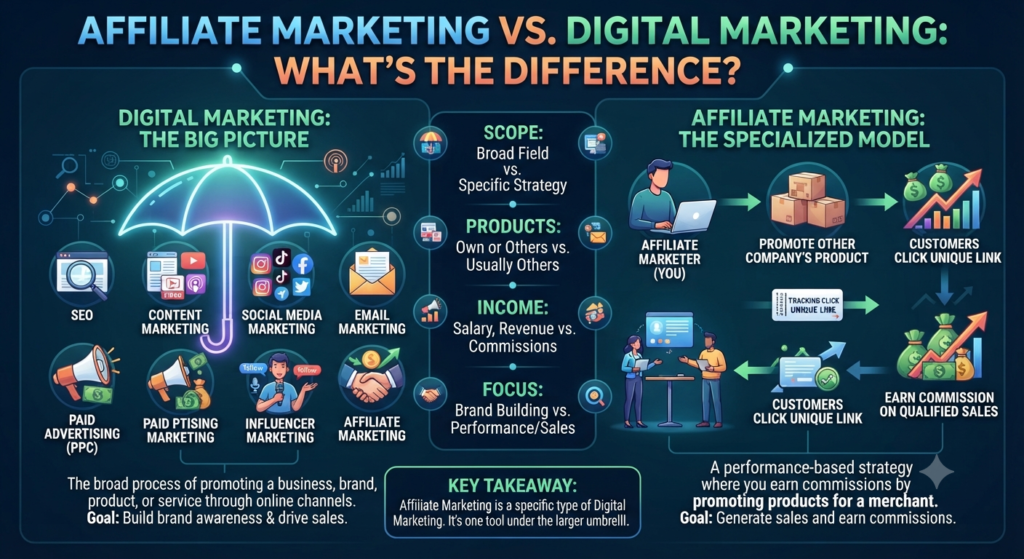
The simple answer is that affiliate marketing is one part of the larger digital marketing world. Digital marketing covers many different ways of promoting a business online, while affiliate marketing focuses specifically on earning commissions by promoting someone else’s products or services.
Let’s break it down.
What Is Digital Marketing?
Digital marketing is basically the process of promoting a business, product, service, or brand through online channels.
Instead of relying only on traditional advertising such as newspapers, billboards, or television, businesses use the internet to reach potential customers.
Some common types of digital marketing include:
- Search engine optimization (SEO)
- Social media marketing
- Content marketing
- Email marketing
- Pay-per-click advertising (PPC)
- Influencer marketing
- Video marketing
- Affiliate marketing
So, digital marketing is a pretty broad field.
For example, a company might use SEO to appear in Google search results, post videos on YouTube, run Facebook or Instagram ads, and send promotional emails to existing customers.
All of those activities fall under digital marketing.
What Is Affiliate Marketing?
Affiliate marketing is a little more specific.
In affiliate marketing, you promote another company’s product or service and receive a commission when someone makes a qualifying purchase or completes another required action through your referral.
Here’s a simple example.
Imagine you have a website about AI tools.
You write an honest review of an AI writing platform and include your affiliate link. Someone reads your review, clicks your link, and signs up for the service.
If the company has an affiliate program and the referral qualifies, you receive a commission.
You don’t create the software.
You don’t handle customer support.
You simply recommend the product and earn when your referral generates a qualifying result.
That’s the basic idea behind affiliate marketing.
Affiliate Marketing vs Digital Marketing: The Main Difference
The easiest way to understand the difference is this:
Digital marketing is the bigger category, while affiliate marketing is one specific type of online marketing.
Think of digital marketing as a large umbrella.
Under that umbrella, you have SEO, social media, email marketing, paid advertising, content marketing, and affiliate marketing.
Affiliate marketing can also use many of the same marketing channels.
For example, an affiliate marketer might use:
- SEO to get traffic from Google
- YouTube to create product reviews
- TikTok to reach a larger audience
- Email marketing to promote relevant products
- Blog posts to answer questions and recommend products
So affiliate marketing and digital marketing aren’t really competitors.
Affiliate marketing can be part of a digital marketing strategy.
Affiliate Marketing vs Digital Marketing: Key Differences
| Feature | Affiliate Marketing | Digital Marketing |
|---|---|---|
| Main goal | Earn commissions from referrals | Promote a business, brand, product, or service |
| Products | Usually someone else’s products | Your own or someone else’s |
| Income | Mainly commissions | Salary, business revenue, fees, leads, or commissions |
| Customer ownership | Usually belongs to the product company | Can belong to your own business |
| Main channels | SEO, blogs, YouTube, social media, email | SEO, PPC, social media, email, content, video, affiliate marketing |
| Startup cost | Can be relatively low | Can range from low to very high |
| Business model | Performance-based | Many different business models |
Which One Is Better for Beginners?
This really depends on what you’re trying to achieve.
If you want to promote your own business, digital marketing is the better term to think about.
For example, suppose you own an online clothing store.
You could use SEO, Instagram, Facebook ads, email marketing, and content marketing to bring customers to your store.
That’s digital marketing.
But if you don’t have your own product and want to earn money by recommending products from other companies, affiliate marketing may be a better starting point.
You could build a website, create product reviews, publish comparison articles, and earn commissions from your referrals.
Is Affiliate Marketing Easier Than Digital Marketing?
Affiliate marketing can be relatively simple to understand, but that doesn’t mean it’s easy.
The basic concept is straightforward:
Find a useful product → recommend it → send people to the product → earn a commission.
The difficult part is getting the right people to see your recommendations.
That’s where digital marketing skills become useful.
An affiliate marketer may need to understand SEO, content creation, social media, email marketing, keyword research, and conversion optimization.
So even if you’re focusing on affiliate marketing, you’ll probably end up learning many digital marketing skills along the way.
How Much Does It Cost to Start?
One reason beginners are attracted to affiliate marketing is that you don’t necessarily need to create your own product.
You can start with relatively little money, especially if you’re using free platforms and creating content yourself.
However, a serious affiliate website may still have expenses such as:
- Domain name
- Web hosting
- Website design
- SEO tools
- Content creation
- Advertising
Digital marketing can also be started with a small budget, but costs can increase quickly if you’re running paid advertising campaigns or hiring professionals.
There’s no single price for either model.
Your costs depend heavily on the strategy you choose.
How Do Affiliate Marketers Get Traffic?
Traffic is one of the biggest pieces of the puzzle.
Without visitors, even the best affiliate offer won’t generate much income.
Some common traffic sources include:
SEO
You create useful articles that target questions people search for on Google and other search engines.
For example:
Best AI Writing Tools for Students
Canva vs Adobe Express
Best Email Marketing Software for Small Businesses
These types of articles can attract people who are already interested in a particular product or solution.
YouTube
Video reviews, tutorials, comparisons, and demonstrations can work well for affiliate marketing.
Someone watching a detailed product review may already be close to making a purchasing decision.
Social Media
Platforms such as TikTok, Instagram, Facebook, and Pinterest can help you reach new audiences.
However, each platform has its own audience and content style, so what works on one may not work on another.
Email Marketing
Once you build an email list, you can communicate directly with people who have chosen to hear from you.
This can be valuable for both affiliate marketing and traditional digital marketing.
Can You Do Both?
Absolutely.
In fact, combining the two can make a lot of sense.
Imagine you run a website about business software.
You could use digital marketing techniques to attract visitors through SEO, social media, and content marketing.
Then you could monetize some of that traffic through affiliate partnerships with relevant software companies.
In this situation, you’re using digital marketing to grow your audience and affiliate marketing to monetize part of that audience.
That’s a pretty common approach.
Affiliate Marketing vs Digital Marketing: Which Should You Choose?
Here’s a simple way to decide.
Choose Affiliate Marketing If:
- You don’t have your own product
- You want to earn commissions
- You enjoy writing reviews or creating content
- You’re interested in building a niche website
- You want to recommend products you genuinely find useful
- You’re willing to build traffic over time
Focus on Digital Marketing If:
- You own a business
- You want to promote your own products or services
- You want to build a brand
- You want to work in marketing professionally
- You want to learn multiple online marketing channels
And there’s nothing stopping you from doing both.
Learning digital marketing can actually make you a better affiliate marketer.
Affiliate Marketing vs Digital Marketing: Which Makes More Money?
There’s no universal answer.
Digital marketing can generate significant revenue when it’s used to grow a successful business, but affiliate marketing can also become a substantial income stream for publishers with strong audiences and traffic.
Your results depend on things such as:
- Your niche
- Audience size
- Traffic quality
- Products you promote
- Conversion rates
- Commission rates
- Content quality
- Marketing strategy
It’s better to focus on building a useful audience than chasing a specific income number.
A smaller audience that trusts your recommendations can sometimes be more valuable than a huge audience that doesn’t care about what you’re promoting.
Final Thoughts
When comparing affiliate marketing vs digital marketing, the most important thing to remember is that they’re not really two completely separate worlds.
Digital marketing is the broad field. Affiliate marketing is one business model within that field.
If you’re promoting your own business, you’ll probably want to learn digital marketing.
If you’re interested in earning commissions by recommending other companies’ products, affiliate marketing may be a good option.
And if you’re serious about affiliate marketing, learning SEO, content marketing, social media, email marketing, and other digital marketing skills can give you a big advantage.
The best approach is to start with one strategy, learn how it works, and improve as you go.
You don’t need to master every part of digital marketing on day one.
Start small, create something useful, and build from there.
Frequently Asked Questions
Is affiliate marketing part of digital marketing?
Yes. Affiliate marketing is generally considered one type of digital marketing. It involves using online channels to promote products or services and earning a commission from qualifying referrals.
What is the difference between affiliate marketing and digital marketing?
Digital marketing is a broad term covering many online marketing methods. Affiliate marketing is a specific performance-based model where you promote another company’s products or services in exchange for commissions.
Which is better for beginners: affiliate marketing or digital marketing?
It depends on your goal. Affiliate marketing can be a good option if you want to earn commissions without creating your own product. Digital marketing is more useful if you want to promote your own business or build a career in marketing.
Can I learn digital marketing and affiliate marketing together?
Yes. In fact, learning digital marketing skills such as SEO, content marketing, social media, and email marketing can help you become a more effective affiliate marketer.
Can affiliate marketing be a full-time career?
It can become a full-time business for some people, but results vary significantly. It usually takes time to build traffic, trust, and consistent commissions, so it’s best to treat it as a long-term project rather than a quick way to make money.
Do I need a website for affiliate marketing?
No, not always. Some affiliate marketers use YouTube, social media, email, or other channels. However, having your own website can give you more control over your content, SEO, and audience-building strategy.